

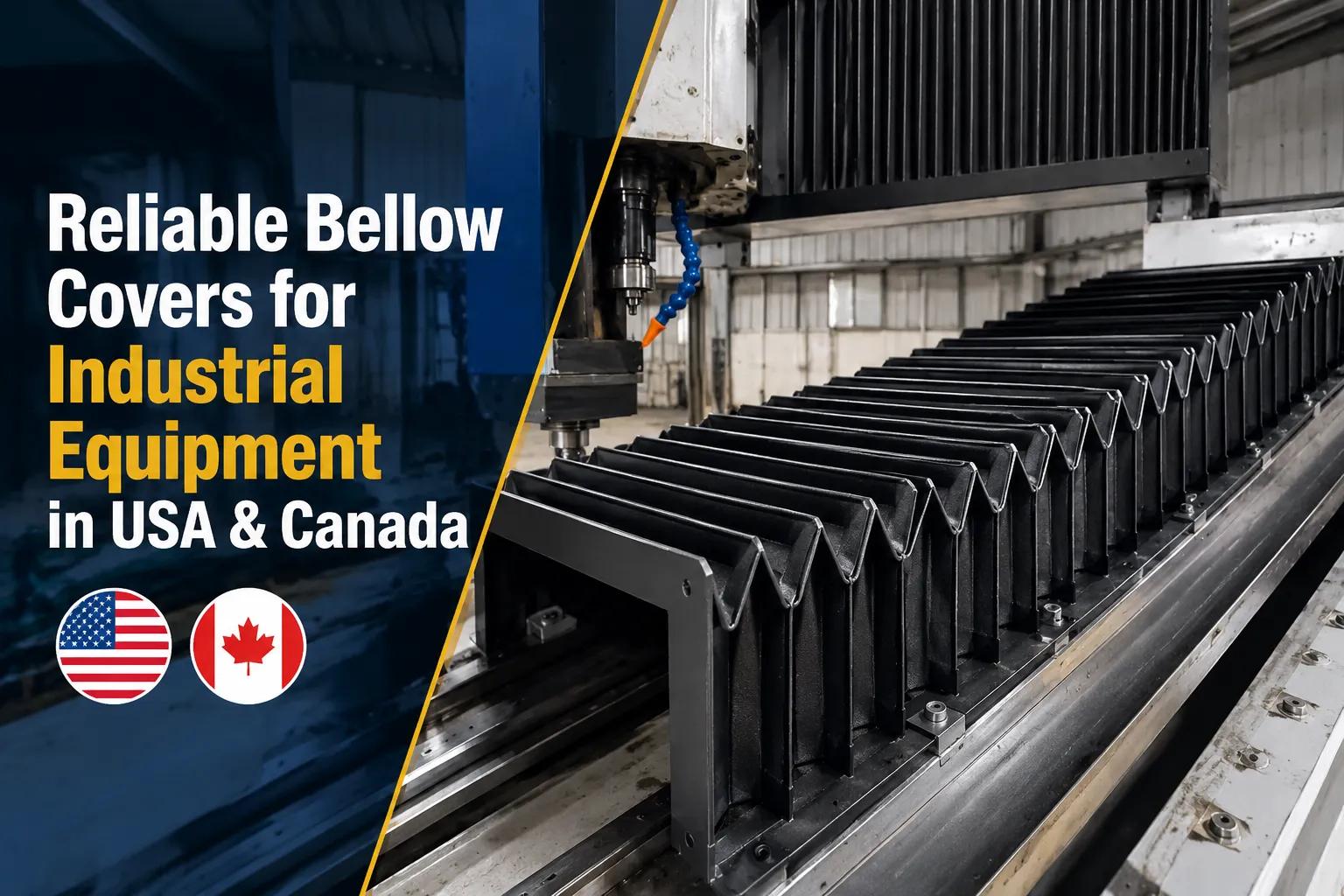
Industrial machines are built to perform under demanding conditions, but even the most advanced equipment needs protection from dust, chips, debris, moisture, and constant mechanical movement. This is where protective bellows become an important part of machine design. A well-designed cover can shield sensitive components while allowing them to move smoothly and efficiently.
For manufacturers and industrial operators across the USA and Canada, choosing the right Bellows Cover Manufacturer can make a noticeable difference in equipment reliability and maintenance. Custom rubber bellows can be designed around the machine’s dimensions, movement, environment, and protection requirements rather than forcing a standard product to fit.
What Are Bellow Covers?
Bellow covers are flexible protective components designed to cover moving machine parts. They expand, contract, fold, or flex as equipment moves, creating a barrier between sensitive mechanisms and the surrounding environment.
They are commonly used on CNC machines, linear guides, hydraulic systems, actuators, automation equipment, and other industrial machinery where exposed components need protection.
Unlike rigid guards, a flexible cover can follow the movement of a machine without significantly restricting its range of motion. This makes it especially useful in applications where space is limited, and components move repeatedly throughout the working cycle.
Why Are Accordion Bellows Popular In Industrial Machinery?
The folding construction of accordion bellows allows the cover to compress and expand while maintaining protection around the moving mechanism. The individual folds provide flexibility without requiring a large installation area.
An accordion bellows cover can be manufactured in different sizes and configurations depending on the application. This makes it suitable for protecting linear rails, guideways, shafts, slides, and other moving components.
For CNC and precision machinery, the ability to create a compact protective solution is particularly valuable. A properly designed accordion bellows cover can help prevent machining debris and other contaminants from reaching sensitive machine components.
Protecting CNC Machines From Dust And Debris
CNC machines operate in environments where metal chips, coolant, dust, and other contaminants can accumulate quickly. Without suitable protection, these materials may reach guideways, screws, bearings, or other moving components.
An accordion dust cover can create an effective barrier while allowing the machine’s moving sections to travel as required. For equipment with demanding operating cycles, the cover must be designed to withstand repeated folding without premature cracking, tearing, or deformation.
An accordion bellows cover for CNC machine applications can also be customized according to available space, travel distance, mounting arrangements, and machine geometry. This is important because CNC equipment can vary significantly from one design to another.
Rectangular And Round Configurations
Industrial equipment does not follow one universal shape. Some assemblies require long rectangular protection, while others need a compact cylindrical or round configuration.
A rectangular accordion bellows cover can be developed for machine guideways, linear systems, and other components with wider or flat profiles. Its geometry can be adapted to suit the available installation space.
For shafts and circular mechanisms, a round accordion bellows cover may provide a more natural fit. The circular design can surround the moving component while allowing the bellows to compress and extend as required.
This variety gives equipment designers more flexibility when selecting protective solutions.
How Do Machine Protection Bellows Support Equipment Life?
Small protective components can have a major impact on larger machines. When contaminants reach guideways, bearings, shafts, or other moving parts, they can contribute to wear and maintenance problems.
Machine protection bellows help reduce this exposure by creating a physical barrier between the working environment and vulnerable components.
In addition to protecting against debris, machine protection bellows can help reduce the frequency of cleaning and maintenance in suitable applications. This can be especially valuable in manufacturing environments where equipment downtime can affect production schedules.
Custom Design For Industrial Applications
Not every machine can use an off-the-shelf cover. Differences in travel distance, dimensions, mounting points, fold requirements, and operating conditions can make customization necessary.
Working with an experienced Bellows Cover Manufacturer allows engineers to discuss these requirements before production. Drawings, dimensions, photographs, movement specifications, and environmental details can all help determine the appropriate design.
Custom manufacturing can also make it possible to develop covers for unusual machine geometries. Whether the requirement involves an accordion dust cover, a rectangular configuration, or a round design, the final product can be developed around the equipment rather than around a generic size.
Choosing The Right Protective Bellows
Before selecting a protective cover, manufacturers should consider several practical factors:
What component needs protection?
How far does the component travel?
How frequently does it move?
What contaminants are present?
Will the cover encounter coolant, oil, chemicals, or heat?
Is the available installation space limited?
Does the machine require a rectangular or round configuration?
What mounting method will be used?
How many operating cycles are expected?
Answering these questions early can help avoid compatibility problems and ensure that the protective cover performs as intended.
A Practical Investment In Machine Reliability
A protective bellows may not be the most visible component of an industrial machine, but its role can be significant. Keeping sensitive moving parts protected can help reduce exposure to contaminants and support smoother equipment operation.
For companies operating machinery across the USA and Canada, selecting a dependable Bellows Cover Manufacturer is therefore about more than simply purchasing a rubber cover. It is about finding a solution that matches the machine’s movement, environment, dimensions, and long-term operating requirements.
Whether the application requires accordion bellows, an accordion bellows cover, or a specialized flexible bellows cover, the right design can provide practical protection without interfering with machine performance.
Conclusion: Industrial machinery works best when its critical components are protected from the environment around them. From CNC equipment and automated systems to linear motion assemblies and hydraulic machinery, protective bellows can provide flexible coverage where rigid guards are not practical.
Custom solutions allow manufacturers to address different shapes, travel requirements, materials, and installation limitations. With the right design and material selection, bellow covers can help protect valuable machine components while supporting reliable day-to-day operation.
For businesses looking for dependable protection, partnering with an experienced Bellows Cover Manufacturer can be a practical step toward improving machine protection and reducing avoidable maintenance concerns.
FAQs:-
1. What is an accordion bellows cover used for?
An accordion bellows cover is primarily used to protect moving machine components from dust, chips, coolant, moisture, and other contaminants. Its folded construction allows it to expand and contract as the machine moves.
2. Can a bellows cover be customized for a CNC machine?
Yes. An accordion bellows cover for CNC machine applications can be customized according to the machine’s dimensions, travel distance, mounting arrangement, available space, and environmental conditions.
3. What is the difference between a flexible bellows cover and a standard machine guard?
A flexible bellows cover is designed to move with the protected component, making it suitable for applications involving repeated linear or mechanical movement. A rigid machine guard may provide protection but can be less suitable where the protected component needs to move continuously.